By Karalee Greer | Elevate News | July 6-12, 2026
Subscription to WBN and being a Contributor is Free
History is shaped by remarkable moments of courage, discovery, conflict, creativity, and innovation. The week of July 6 to July 12 brings together events that transformed governments, inspired social movements, advanced science, and changed the course of world history. From the birth of modern currency systems to legendary musical partnerships and decisive moments in global conflict, this week reminds us how individual events can leave lasting legacies.
North America
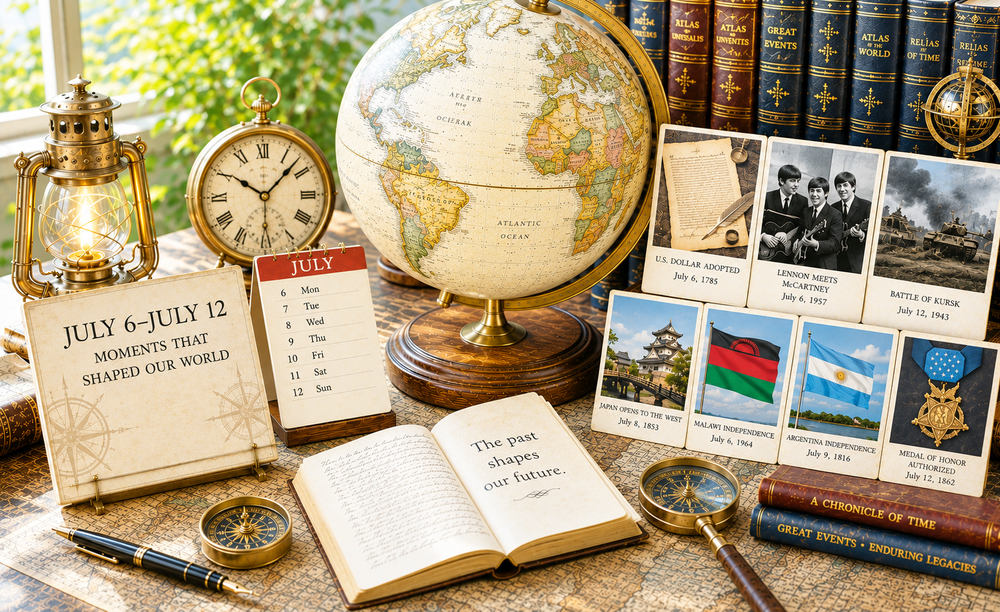
On July 6, 1785, the Continental Congress adopted the United States dollar as the nation's official currency, making it the first country to adopt a decimal-based monetary system. The decision helped establish a financial foundation that continues today.
On July 11, 1804, U.S. Vice President Aaron Burr fatally wounded former Treasury Secretary Alexander Hamilton in a duel near Weehawken, New Jersey. The confrontation remains one of the most famous political rivalries in American history.
On July 12, 1862, the U.S. Congress authorized the Medal of Honor, the nation's highest military decoration for acts of extraordinary bravery and valor in combat.
Europe
On July 6, 1415, Czech religious reformer Jan Hus was executed after being condemned for heresy at the Council of Constance. His death inspired the Hussite movement and became an important precursor to the Protestant Reformation.
On July 6, 1957, John Lennon first met Paul McCartney at a church fête in Liverpool, England. Their partnership would lead to the formation of one of the most influential songwriting teams in music history through The Beatles.
On July 12, 1943, one of history's largest tank battles took place near Prokhorovka during the Battle of Kursk. The battle marked a turning point on the Eastern Front during the Second World War.
Asia
On July 7, 1937, the Marco Polo Bridge Incident near Beijing triggered the Second Sino-Japanese War, a conflict that became one of the major theatres of the Second World War in Asia.
On July 8, 1853, Commodore Matthew Perry arrived in Edo Bay, Japan, beginning negotiations that would eventually end Japan's centuries-long policy of relative isolation and open the country to international trade.
Africa
On July 6, 1964, Malawi gained independence from the United Kingdom, becoming a sovereign nation within the Commonwealth and beginning a new chapter in its national history.
On July 6, 1975, the Comoros declared independence from France. The island nation in the Indian Ocean became one of Africa's newest independent states during the era of decolonization.
South America
On July 9, 1816, delegates meeting at the Congress of Tucumán formally declared the independence of Argentina from Spain. The declaration became one of the defining moments in South America's struggle for independence.
On July 10, 1821, American naval officer and explorer David Porter arrived in the Galápagos Islands during his Pacific expedition, helping expand international scientific and geographic knowledge of the archipelago that would later become central to Charles Darwin's studies.
Science and Technology Watch
The week of July 6 to July 12 highlights the power of innovation and collaboration. The adoption of the U.S. dollar demonstrated how standardized financial systems could support growing economies, while the chance meeting of John Lennon and Paul McCartney showed how creative partnerships can reshape global culture for generations.
The period also reflects advances in exploration and international exchange, as Japan's opening to the West transformed diplomacy, commerce, and technological development throughout Asia and beyond.
Weather and Nature Watch
Early July brings midsummer conditions across much of the Northern Hemisphere, with long days supporting agriculture, tourism, festivals, and outdoor recreation. Heat waves, wildfire monitoring, and drought conditions become increasingly important across many regions.
In the Southern Hemisphere, winter weather continues to influence farming, ecosystems, and water resources as cooler temperatures dominate much of South America, southern Africa, and Australia.
Series Note: “On This Week” explores significant global events, discoveries, turning points, and cultural milestones connected to each calendar week throughout the year.”
Editor: Karalee Greer LinkedIn: https://www.linkedin.com/in/karalee/ Subscription to WBN and being a Contributor is Free
Tags: #WBN News Vancouver #On This Week #World History #Karalee Greer #Interesting Facts #Global Events