
On This Week | August 17–23, 2026: Moments That Shaped Our World
Excerpt: From independence and voting rights to the Geneva Convention, space exploration and Lake Nyos, August 17–23 reveals a remarkable week in history.

Excerpt: From independence and voting rights to the Geneva Convention, space exploration and Lake Nyos, August 17–23 reveals a remarkable week in history.
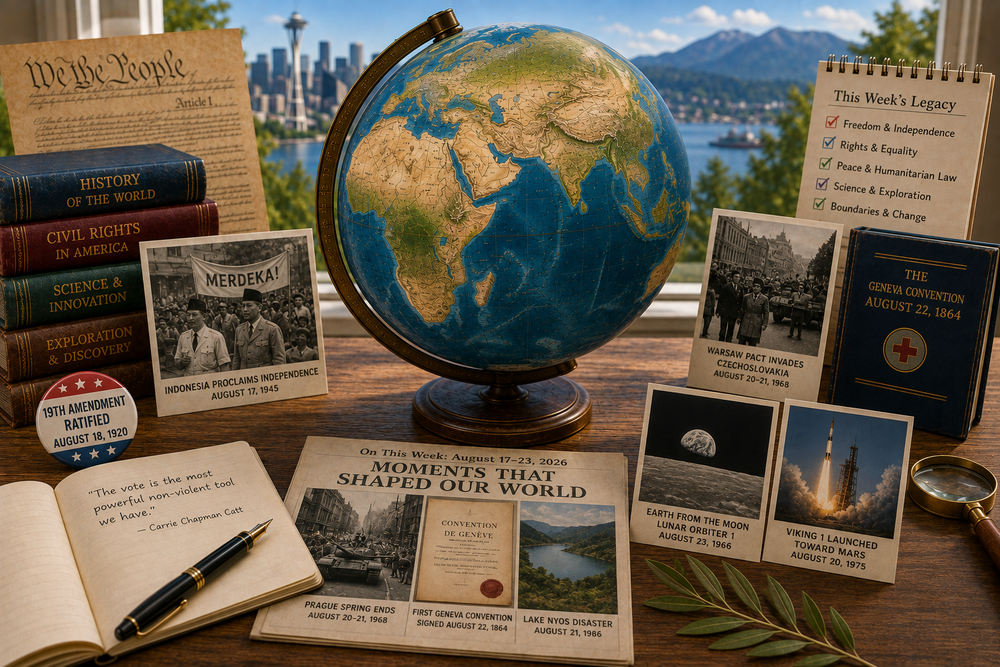
By Karalee Greer | Elevate News | August 17-23, 2026
Subscription to WBN and being a Contributor is Free
Editor’s Note: “On This Week” features the strongest verified historical events connected to each calendar week. Historical significance takes priority over including every region equally.
The week of August 17 to 23 carries an extraordinary theme: boundaries — and the people who challenged, crossed, created, or were divided by them.
Indonesia proclaimed independence. Women in the United States secured a constitutional guarantee of voting rights. Hawaii became America's 50th state. Soviet tanks crossed into Czechoslovakia. A treaty in Geneva began establishing international protections for wounded soldiers. In the Caribbean, an uprising by enslaved people helped set Haiti on the road toward independence.
Humanity was also pushing beyond another kind of boundary — Earth itself. Soviet space dogs returned safely from orbit, Viking 1 began its journey to Mars, and Lunar Orbiter 1 gave humanity a remarkable new perspective on its home planet.
On August 18, 1920, Tennessee became the 36th state to ratify the 19th Amendment to the United States Constitution, providing the final state approval needed for ratification.
The amendment declared that voting rights could not be denied or abridged on account of sex. Its adoption followed generations of organizing, petitions, marches, lobbying, protest, imprisonment, and civil disobedience by women's suffrage advocates.
The achievement was historic, but it did not mean that every American woman could immediately vote freely. Discriminatory laws and practices continued to prevent many Black women, Indigenous women, Asian American women, and others from fully exercising voting rights for decades afterward.
The amendment was formally certified on August 26, 1920.
On August 21, 1959, President Dwight D. Eisenhower issued the proclamation admitting Hawaii as the 50th state of the United States.
The milestone followed decades of debate over Hawaii's political status. It also came after a much longer and more complicated history that included the overthrow of the Hawaiian monarchy in 1893 and U.S. annexation in 1898 — actions that were opposed by many Native Hawaiians.
Statehood therefore represents both an important milestone in modern U.S. history and part of a larger history of Hawaiian sovereignty that continues to shape discussion today.
During the night of August 22 to 23, 1791, enslaved people in the French colony of Saint-Domingue rose in rebellion.
The uprising developed into the Haitian Revolution, a long struggle that culminated in Haiti declaring independence in 1804.
It became the only successful large-scale revolt of enslaved people to establish an independent state and sent shock waves throughout societies dependent upon slavery.
The event was so consequential to the history of slavery and abolition that UNESCO chose August 23 as the International Day for the Remembrance of the Slave Trade and its Abolition.
On the night of August 20–21, 1968, Soviet-led Warsaw Pact forces invaded Czechoslovakia.
The invasion brought an abrupt end to the Prague Spring, a reform movement led by Alexander Dubček that had attempted to create a more open form of socialism with greater freedom of expression and political reform.
Tanks entered Prague and other major cities as occupying forces took control of transportation and communications.
Although the invasion halted the reforms, it also damaged the Soviet Union's international reputation and exposed growing divisions within the communist world.
The Prague Spring would remain an enduring symbol of resistance to authoritarian control until communist rule collapsed across much of Eastern Europe two decades later.
On August 21, 1911, Leonardo da Vinci's Mona Lisa was stolen from the Louvre in Paris.
The thief, Vincenzo Peruggia, had previously worked at the museum. He removed the painting from its display and carried it out of the building.
The theft generated international headlines. The painting remained missing for more than two years before being recovered in Italy in 1913.
Ironically, the crime helped transform a celebrated Renaissance portrait into perhaps the world's most recognizable painting. The disappearance generated enormous public fascination, and crowds came to the Louvre even to stare at the empty space where it had hung.
On August 22, 1864, representatives meeting in Geneva adopted the Convention for the Amelioration of the Condition of the Wounded in Armies in the Field.
Sixteen states had participated in the diplomatic conference.
The agreement established revolutionary principles for warfare, including protection for wounded soldiers regardless of nationality and recognition of neutrality for medical personnel, hospitals, and ambulances caring for the wounded.
It became the foundation upon which the later Geneva Conventions — and much of modern international humanitarian law — would be built.
On August 23, 1939, Nazi Germany and the Soviet Union signed the German-Soviet Non-Aggression Pact, commonly known as the Molotov-Ribbentrop Pact.
Publicly, the two powers agreed not to attack one another.
Secret provisions, however, divided parts of Eastern Europe into German and Soviet spheres of influence.
The agreement removed a major strategic obstacle to Adolf Hitler's planned invasion of Poland. Germany invaded Poland on September 1, and the Soviet Union invaded from the east later that month.
The pact therefore became one of the crucial diplomatic steps immediately preceding the outbreak of the Second World War in Europe.
On August 17, 1945, just two days after Japan announced its surrender in the Second World War, Sukarno and Mohammad Hatta proclaimed Indonesia's independence.
At approximately 10 a.m. in Jakarta, Sukarno read the short proclamation declaring that the Indonesian people had taken control of their own destiny.
The declaration did not immediately settle Indonesia's status. The Netherlands attempted to re-establish colonial rule, leading to several years of armed and diplomatic struggle before Dutch recognition of Indonesian sovereignty in 1949.
Today, August 17 is celebrated throughout Indonesia as Independence Day.
Just days after India and Pakistan became independent, the boundaries dividing the two new countries were publicly announced on August 17, 1947.
The Radcliffe Line divided Punjab and Bengal between India and Pakistan.
The borders had been drawn in extraordinary haste. Millions of people suddenly discovered that their homes, communities, religious sites, farms, and businesses were now on one side or the other of a new international frontier.
More than 15 million people are estimated to have migrated across the new borders during Partition, accompanied by widespread communal violence and enormous loss of life.
The consequences of those boundaries continue to influence relations across South Asia today.
On the evening of August 21, 1986, an almost invisible natural disaster struck communities surrounding Lake Nyos in Cameroon.
A massive cloud of carbon dioxide suddenly escaped from the deep volcanic crater lake and flowed downhill into surrounding valleys. Because carbon dioxide is heavier than air, it displaced breathable oxygen near the ground.
People and animals lost consciousness with little warning.
Approximately 1,700 people died, along with thousands of livestock.
Scientists determined that volcanic carbon dioxide had accumulated in the lake's deep waters over time before being catastrophically released — a rare phenomenon now known as a limnic eruption.
The tragedy fundamentally changed scientific understanding of gas-rich volcanic lakes and led to monitoring and controlled degassing efforts designed to reduce the possibility of another catastrophe.
Three remarkable anniversaries this week trace the rapid evolution of space exploration.
On August 19, 1960, the Soviet Union launched Belka and Strelka aboard Sputnik 5 along with other animals and biological specimens.
They returned safely the following day, becoming the first living creatures to orbit Earth and survive the journey back. Their flight provided important information ahead of human orbital missions.
On August 20, 1975, NASA launched Viking 1 toward Mars.
After an approximately 11-month journey, Viking 1 successfully landed on Mars on July 20, 1976. Its lander and orbiter dramatically expanded scientific understanding of the Martian surface and atmosphere and searched for evidence of life.
Then came an image that changed humanity's perspective.
On August 23, 1966, NASA's Lunar Orbiter 1 photographed Earth from the vicinity of the Moon — the first photograph of Earth taken from that distance.
Earth appeared suspended above the Moon's horizon, offering an early glimpse of the perspective that later became synonymous with the space age: our enormous, complicated world seen as one small planet in space.
One of the most important environmental stories of August 2026 continues to unfold across the world's oceans.
The World Meteorological Organization reports that El Niño is strengthening rapidly in the tropical Pacific and is expected to become a strong event during August through October.
El Niño changes the movement of heat between the ocean and atmosphere and can alter rainfall, drought, tropical storm activity, and temperatures thousands of kilometres away.
This year's event is developing while global ocean temperatures are already exceptionally warm, increasing concern about compounding climate extremes.
Those extremes are particularly visible in Europe, where wildfires have continued across several countries this week.
Belgium has been battling what authorities described as its largest wildfire on record in the High Fens nature reserve, while fires have also affected Greece, Spain, Portugal, Croatia, France, Germany, and parts of the United Kingdom. More than 576,000 hectares had burned across Europe in 2026 by August 17.
Here in British Columbia, hot and dry conditions have also increased wildfire concerns in the Interior. As of August 16, approximately 429,400 hectares had burned across the province this season, with forecasters warning that late-week heat could worsen existing fire conditions before cooler weather and showers arrive.
There is still something beautiful to look for overhead.
The Perseid meteor shower remains active through August 24, even though its peak occurred last week. NASA says observers under dark skies can still catch occasional bright Perseid meteors streaking across the late-summer sky.
History reminds us that borders, governments, technologies, and societies can change remarkably quickly. Nature reminds us that the world on which all of that history unfolds is changing too.
Series Note: “On This Week” explores significant global events, discoveries, turning points, and cultural milestones connected to each calendar week throughout the year
Editor: Karalee Greer | Elevate News LinkedIn: https://www.linkedin.com/in/karalee/ Subscription to WBN and being a Contributor is Free
Tags: #Elevate News #On This Week #World History #Karalee Greer #Interesting Facts #Global Events